Showing posts with label adventure. Show all posts

12 June, 2009

The Friday Babble: Let it snow, let it snow, let it snow.

I'm going away this weekend - flying down south this very evening! Now, to the majority of my readers, 'down south' means, 'to a warmer climate'. Sadly, when you live in the Southern Hemisphere, the further south you get the greater your chances of freezing to death are. My luggage is almost entirely packed with thermal underwear and woolen clothing, but if you never hear from me again it will mean there is a new, somewhat attractively-shaped icicle somewhere in the heart of Dunedin, New Zealand.

Dunedin is where I went to university, by the way. The student flats there are renowned for their shittiness, and generally it was a good five degrees colder inside your room than it was outside in the fresh air. Generally you got at least one text every day from a friend which simply read, "Fk its cld." It wasn't that we were deeply invested in using abbreviations in our SMSs, it was because it was so fucking cold we couldn't move our fingers.

I remember those years fondly.

Anyway, returning to the place where I (mis)spent my youth - or as one friend endearingly nicknamed it, "that shithole" - has made me think about books where winter, especially winters of ice and snow, play a particular role. Traditionally, winter is seen as a bad time, which is pretty understandable. Winter was for a long time - and still is, for many people - the time of year where you can't simply live, but must try to survive; there was no work and no income, no fresh food, and families had to try and keep themselves and their animals alive until spring. If you wandered outside and a snowstorm hit, you were a gonna. Grim stuff, I know. And people still seem to have a deep distrust of winter, even people who can afford gas-fires and insulation and snowmobiles and a sexy wool hats with a pompom at the top.

So, here are some books where winter is more than mere scenery. If you do reside in the Northern Hemisphere I know this may seem a little unseasonable, but I guess you could always save this post and come back and look again in six months' time.


Title: Hatchet Winter (1996)
aka Brian's Winter and Hatchet: WInter
Author: Gary Paulsen
Gary Paulsen wrote a book called "Hatchet", about a boy named Brian who finds himself alone in the Canadian wilderness after the plane he's on crash-lands. It's a pretty thrilling book, all about how he learns to survive - forage for food, build his own shelter, protect himself from wild animals, etc etc. Since it's a children's book, it ends with the kid getting rescued.

But a lot of people wrote to Paulsen saying, "Surviving in the summer is all very well, but how would Brian have coped with the freezing winter temperatures?" In response, he produced Hatchet Winter, in which the boy was never rescued and is stuck for the winter. Brian's chances of survival suddenly get a lot slimmer. Also, he's attacked by a bear! Awesome.


Title: Child-44 (2008)
Author: Tom Rob Smith
As well as cannibalism there was a hell of a lot of snow. Are there any Russian novels in which there isn't any fucking snow?


Title: Moominland Midwinter (1957)
Author: Tove Jansson
Finally, a story where snow is actually seen as being kinda cool! No pun intended. Moomins always hibernate over winter, but this year Moomintroll just can't get to sleep. Instead he discovers everything there is to know about this mysterious time of the year - he learns to ski, he learns to ice fish and he meets the Dweller Under the Sink; but he also discovers there is a dark side to winter, and that death befalls anyone who meets the Lady of the Cold...


Title: The Snow Queen (1845)
Author: Hans Christian Andersen
I loved this story as a kid, partly because it is a fairytale in which a girl rescues a boy and not the other way around, but also because it is one of the few of Andersen's stories which actually has a happy ending. Seriously, the first time I read the original ending to The Little Mermaid I nearly had a heart-attack. It was also the start of my long-term vendetta against Disney, but that's another story.

Anyway, it's a beautiful story, and as a child I completely missed the religious overtones (for instance, Gerda says the Lord's Prayer to enter the Snow Queen's palace - I don't think I even knew what the Lord's Prayer was when I first read that.) It did give me the lasting impression that Europe is a terrifyingly cold place, though.


Title: The Lion, the Witch and the Wardrobe (1950)
Author: C. S. Lewis
First of all, you know that atrocious movie version of this book that came out a few years ago? We're not going to talk about it. We're especially not going to talk about how badly they raped Prince Caspian which I'm pretty sure they did just to piss me off.

Anyway, I love the Narnia series and I love this book. Even the overt symbolism of Aslan (aka as my homeboy, Jesus) bringing spring to the wintery land of Narnia which has been overtaken by the evil White Witch does nothing to diminish my love for it. I reread the whole series about once a year (except for The Last Battle, sorry) and it still continues to amaze me.

Although my seven-year-old self was really confused by the concept of "Always winter, but never Christmas!" Christmas happens in the middle of summer and anyone who says otherwise is wrong.


Um.

In conclusion, I think what we have all learned today is that winter is a terrible time, brought about by evil women who enjoy making small children suffer. Winter may very well kill you, unless you are a small Finnish troll or happen to have an ax handy.

An important lesson for us all.

28 March, 2009

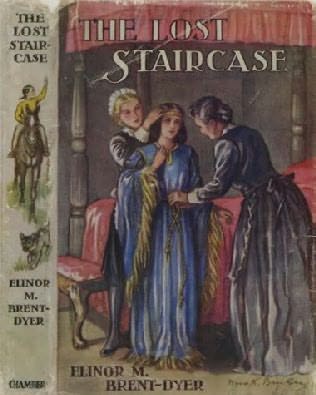
Book 5 - The Lost Staircase

I have two weaknesses when it comes to reading. One is mystery-slash-detective stories (more on that later) and the other is British children's stories written in the first half of the 20th Century. You know, The Secret Garden, The Railway Children, The Famous Five... but I have a particular fondness for books of the Girls Own variety. You know, hockey sticks, midnight feasts, students wearing gymfrocks and calling everything "frightfully smashing!" Enid Blyton's Mallory Towers and St Clare's series are both in the middle of a revival, judging by my last visit to Borders, but my favourite Girls Own author is Elinor M.Brent-Dyer, whose best-known series, the Chalet School, spanned 45 years and 58 books - and she didn't even use a ghost writer. Take that, Francine Pascal and Ann M. Martin!

I've been collecting said series since I was about eight or nine and I'm still twelve books away from completing my collection. These days, the rarest of her hardbacks can go for hundreds of dollars, and I've even seen her paperbacks being sold for $150+. Naturally, the few I have left to go just so happen to be the rarest and the most expensive books to buy, but I live in hope.

Anyway, despite my absolute dedication to the Chalet School, I've never read any of Brent-Dyer's other books, so when a copy of The Lost Staircase came up for sale on trademe at a reasonable price I nabbed it!


Title: The Lost Staircase (1946)

Author: Elinor M. Brent-Dyer

Why this book?
Because of my deep abiding love for Brent-Dyer (see above).

What's it about, anyway?
Sir Ambrose Gellibrand has had his share of tragedies in life, and now, at the age of eighty, he has lost not only his children but all of his grandchildren as well. Realising that he is unlikely to live many more years, he contacts his last remaining heir, who will one day inherit the Dragon House, a large estate nestled on the Welsh border, dating back to the 16th Century.

His last remaining heir turns out to be Jesanne, a fourteen year old girl who is not pleased to be summoned away from her New Zealand farm and her beloved aunt by a cold and distant relative. Incidentally, Jesanne's full name is Jesanne Loveday Balthazar Gellibrand - awesome! What with all this emphasis on people nowadays calling their kids Jermajisty or Space Shuttle or Renesme or whatever, there's not enough children given ridiculously long romantic-sounding names. If I ever have a daughter I'm going to call her Jesanne Loveday Kickass Balthazar Dangerfield so that if she grows up to be a spy she will not only have an appropriate last name - Agent Dangerfield - but she'll also be able to say "Kickass is my middle name".

Anyway, as a 'Colonial', Jesanne struggles at first with the old-world niceties she is now expected to adopt. She doesn't understand why she's supposed to wear gloves outdoors, she hates the fact that she has a maid who actually dresses her in the mornings, and the 'dignity and solemnity' of the butler at mealtimes leaves her speechless. Jesanne is strong-willed, independent and proud, and it is unsurprising that she clashes with her cousin from the very first night of her arrival.

Still, as much as Jesanne misses her own country and her aunt, she slowly learns to love the Dragon House and its grounds. When Cousin Ambrose tells her of the legendary lost staircase, a flight of stairs leading the the Gellibrand's secret chapel which seems to have all but disappeared, her curiousity is piqued. With her cousin's guidance, and the help of her new friend Lois, Jesanne is determined to find out where the staircase is - and why it was hidden in the first place.

The good and the bad:
The worst part about doing a project on the history of book-making is that when I read that the Gellibrand family "Journall" was so old that its paper had been made from rags, and that its quality was inconsistent, I was immediately filled with girlish glee. But moving on.

As a 'Colonial' myself, I find Brent-Dyer's portrait of Jesanne's struggles in the UK to be fairly realistic. New Zealand has always prided herself on being a 'classless' society - and while this is arguably untrue, we have certainly never had the kind of class system that has existed in Britain. While Cousin Ambrose is no longer lord and master of the people in the nearby village, he does still consider it his noblesse oblige to help deal with any problems they face, and in turn relies on their (manual) help at times. The class divides are very prominent and it is only natural that Jesanne will notice this and react against it - although by the end of the book she has clearly absorbed her cousin's views and is prepared to one day take over his role.

Jesanne rebels against both of her authority figures, her cousin and her governess, Miss Mercier. But while Jesanne and Cousin Ambrose's relationship slowly improves to the point that they are able to love one another, Miss Mercier is never treated with much sympathy. It is obvious right from her introduction that she is meant to be an unappealing character; her voice is 'hard', her piano playing is very good, but 'mechanical' - she doesn't have the deeper level of understanding which would allow her to become a truly brilliant musician, and this same lack means she can never be anything but a passable teacher and an unsympathetic person. While Cousin Ambrose and Jesanne bond over their mutual love of the outdoors and animals, Miss Mercier think moonlight walks are silly, and is scared of all dogs, even puppies. While Cousin Ambrose is proud, even arrogant, he ultimately wants to do whatever is best for Jesanne, and is willing to adjust some of his own ideas and prejudices to do so. Miss Mercier, on the other hand, claims to be doing what is best for Jesanne when she is largely acting in her own self-interest.

What makes The Lost Staircase really stand out for me is Jesanne's family history, which is integral to unlocking the mysteries of architecture. How exactly does one misplace a stair? In the case of the Gellibrands, one does it by being Catholic during the wrong time in history - during the English Civil War - and having family members who, although fighting on opposing sides, are unwilling to betray each other. Unfortunately, this backstory is unlikely to make sense to anyone unfamiliar with the Civil War, and is probably the one thing which would make the book unreadable to modern children who would otherwise thoroughly enjoy the story.

So should I read it or what?
The Lost Staircase is very much a product of its time, with its unconscious classism and emphasised "Britishness". There is also a level of religious feeling to the book which I'm sure a lot of people would find off-putting, although as an atheist myself I had no problem with it, since Brent-Dyer's focus is always on the positive aspects of love, understanding and forgiveness. There's an almost innocent quality to the books given its fourteen-year-old protagonist; while Brent-Dyer is not shy on the subject of death, there are are no boys, no crushes, no peer pressure, and certainly no drink, drugs, sex or rock'n'roll - in short, none of the things that we would expect to be included in a book focusing on a contemporary teen heroine.

My judgement? If you know someone with a love for Girls Own, they'll love this book. Otherwise I'd save it for a bright eight- or nine-year-old who is not yet prepared for the ravages of teen angst.