Showing posts with label author: elinor brent-dyer. Show all posts

27 December, 2009

Books 35 - 40: Six (Girls Own) Geese a-layin'.

Seasons greetings! Currently I am in an awesome mood, because a. I got some seriously awesome stuff for Christmas (although sadly few books) b. I'm on holiday until January 5, which allows for some serious reading, and c. this is the view from my deck:


Awwww yeah. I currently have no plans for New Year's, either, so I'm planning on seeing in 2010 by reading as many books as I can in one night. Dorky and socially isolating, sure, but a lot less harrowing for the liver.


35.
Title: Robins in the Abbey (1947)
Author: Elsie J. Oxenham

36.

Title: The New Abbey Girls (1923)
Author: Elsie J. Oxenham

37.

Title: Maid of the Abbey (1943)
Author: Elsie J. Oxenham

Sometimes when you begin reading a new series of books you can start anywhere and pick up what's going on and who's who. The Abbey Girls is not one such series. I started with seventh-to-last book, out of thirty-eight books, and for at least the first three chapters I had no idea what was going on. The main character, one of the titular Robins, was easy enough to grasp. She's a young heiress travelling back to Wales from New York, by ship: when she receives news that her father, also overseas, has been in an accident, she's invited home by Lady Quellyn, who lives at the Abbey.

So far so good, right? Only when she gets to the Abbey the virgin reader - ie me - is confronted with characters by the names of Joy, Jean, Joan, Jandymac and Jen, all who seem to have several pairs of twins who are all named after each other; then there's Rosamund, whose daughters are all named some variation of Rose; as well as their first names, they're all Ladies or Countesses, and Joy used to be Lady Marchwood but she's now Lady Quellyn and Jen is Lady Marchwood; oh, and then they've all got nicnames, after flowers, so they're also called Primrose or Daisy or Hyacinth or Violet and I never knew who anyone was talking about.

Even amongst all this confusion, Oxenham's strengths shone through. Of all the writer of "Girls Own" stories - a term used to describe books written exclusively for girls in the late 19th and early 20th centuries - Oxenham is probably the best known, besides Enid Blyton. Her characters, although not always incredibly complex, are still human: in Robins, the female Robin is impatient and frustrated when she realises she is in love (with a man who has the same name as her) yet she can't approach him because she's a woman, and you really get a sense of how a girl in her position must have felt. Oxenham also writes beautiful, vivid descriptions of her settings, whether it's the English Abbey or Robin's home in Wales.

The New Abbey Girls cleared up a lot of my confusion. It's book 13 in the series, and although it was severely abridged I finally got a handle on who everyone was and why they were so important. Particularly of interest were the scenes where Joy - at this point, neither Lady Marchwood nor Lady Quellyn - takes her new ward, Maidlin, to various folkdancing classes. Folkdancing seems to happen in every single book - as well as the crowning of a May Queen - but here, so early in the series, it seemed a lot more interesting and was better integrated with the story. Even if I'd never heard of any of the dances, it was still fascinating to read about. Sadly, my copy of this book was severely and noticeably abridged, which made the story jump all over the place.

Maid introduces two more characters, Anne and Belinda Belanne, who also appear in Robins. A sick Anne is invited to the Abbey along with her sister, who is delighted to find her idol, the singer Maidlin, lives there. When disaster strikes the Abbey in the form of measles, Anne takes over as cook, and Belinda become a nurse-slash-governess to Joy's twin girls. Maidlin is caught up in her own romantic drama - she's being wooed by a dear friend, but she's in love with his uncle.

The books are mostly light fare, although I'm given to understand that others in the series touch on deeper subjects, such as religion, and death and illness. Fun though, and surprisingly hard to put down.


38.
Title:
Ruey Richardson: Chaletian (1960)
Author: Elinor M. Brent-Dyer

39.
Title:
Cornelia of the Chalet School (2009)
Author: Jackie Roberts

40.
Title:
Before the Chalet School: The Bettanys of Taverton High (2008)
Author: Helen Barber

Ruey Richardson doesn't settle in easily to the Chalet School. Until recently, her and her brothers were more or less looking after themselves, and she's used to going to bed whenever she likes, doing her homework whenever she likes, and has never given much thought to the way she looks or dresses. At boarding school, things are different, and even though her idea for the school to start playing lacrosse quickly brings her new friends, she has less luck with the teachers.

This is kind of an odd book. Brent-Dyer had been writing the Chalet School series for almost forty years at the point, and she kind of makes a conscience effort to modernise her plots. Ruey and her brothers haven't just been abandoned by their father for any old reason: he's a space-mad scientist hoping to fly to the moon. I am not even kidding, it is hilarious/ridiculous. The other odd thing is the lacrosse: there is literally a chapter on lacrosse theory, and it read almost exactly like a text book on the subject. I pretty much skipped that chapter, in case you're wondering.

The other two books I read in this series were, as you can see from my handy list, not written by the original author, which is something I'm not usually super keen on. Cornelia starts off pretty badly, too - Roberts seems to be trying to ape Brent-Dyer's style, and it just feel awkward and uncomfortable to read. The writing picks up later, though, and the story becomes quite interesting - Cornelia, a former Chalet pupil, is travelling back home to America with her millionaire father, on board a ship that includes a former Nazi officer and his wife, and old school-mate of Cornelia. During the war, Brent-Dyer emphasised that just because someone was "the enemy" it didn't make them evil, and Roberts does a good job of carrying this message one. The Nazi officer openly hates Jews, but his wife confides to Cornelia that she herself would have gone to a concentration camp for helping Jewish refugees if he hadn't intervened to save her. He's undoubtedly a terrible person, and yet he is still human.

Taverton High was much more in touch with the original series as far as actual content went. It follows the school's founding family before the founding, as a poor (but not so poor they can't afford a maid!) family of siblings dealing with a lack of funds, a guardian who is kindly but out of his depths, and a very ill little sister, who is painfully close to dying. The narrative focuses both on Joey, the youngest sister who despite being constantly sick is also constantly in and out of trouble: and Madge, the eldest sister, who in the absence of her twin brother is the one who has to try and make ends meet. Among other things, it's an interesting look at English village life during the Depression that followed the World War I.

Brent-Dyer still holds a special place in my heart that Oxenham can't possibly replace, but I'm still keen to read some more of her books. I'm ridiculously close to having read every single book in the Chalet School series anyway - when I finally have, I'll have to find something else to obsess over. Oxenham may be that something!

18 July, 2009

Books 18 and 19 - The New Housemistress and Carnation of Upper Fourth, or: Jolly hockey sticks (without the hockey sticks)

A double whammy this week, since they're both short books and both by the same author (and both of a genre that few people but me are interested in...) If you don't like books of the jolly hockey sticks variety, I suggest scrolling down to where I talk about the awesome movies I've been watching at the film festival. If you don't like films then... shit. I don't know. Maybe take a look at this excerpt from my favourite computer game instead?


Title:
The New House Mistress (1928)

Author: Elinor M. Brent-Dyer

Why this book?
Firstly, since I have a driving passion to own hardcover copies of every book Brent-Dyer ever wrote; and secondly because it was going cheap on trademe. Oh trademe, where would I be without you?

What's it all about anyway?
The Middles at St Helen's School are very upset to hear that their beloved teacher, Miss Lessing, is leaving to get married during the half-term holidays. Lead by the charming and popular Barbara Allen, they decide to treat whoever takes her place as badly as possible, in a misguided attempt to stay loyal to her predecessor. Miss Oswald, the new house mistress, is determined to win the girls over, and almost does so when she saves one of the student's lives. However, Barbara is only more determined to show Miss Oswald she isn't wanted.

Barbara is badly shaken when she hears that her younger sister and brother, both living in India with her parents, were almost killed by a savage crocodile; only the efforts of a mysterious English girl saved their lives. Unable to sleep, she takes to the lawn in the middle of the night for a dance, where she is caught and punished by Miss Oswald. She also runs into trouble with the new teacher when she purposefully throws a tennis match in order to display her dislike for her.

In a final show of rebellion, Barbara and her friends put on a play for the rest of the Middles, the performance to be held in the middle of the night. The chosen play is based on the ballad of Barbara Allen, which, incidentally, I had never heard of before but a few different versions of it can be found here. (Warning: it is pretty dire.) The play is a success, but one of the audience members accidentally sets fire to the dormitories. Barbara finally realises how badly she's been behaving - but her realisation may have come too late, since Miss Oswald has been badly injured in the fire...

The Good and the Bad
This was a pretty quick read, which was a little disappointing since Brent-Dyer's books are usually comparatively substantial. It also meant that she had less time to develop her characters, which again was disappointing, since characterisation is really one of her strengths. As a result we really only got to know Barbara, and I kind of feel like I would have liked her more if I'd seen her before she started acting like a total brat to Miss Oswald. Miss Oswald for her part only narrowly missed being a 'plaster saint' - she wasn't completely perfect, but on the other hand, she did save a total of four lives in the story, on three different occasions, which felt a little heavy-handed (and by 'a little' I mean 'ridiculously').

Title: Carnation of the Upper Fourth (1934)

Author: Elinor M. Brent-Dyer

Why this book? I actually read this book online, which always ruins a little of the magic for me, but I've never ever even see a copy of it for sale, and also reading it online it was free. Sweet.

What's it all about anyway?
Carnation has been travelling the world with her artist father, and has therefore never been to school before. Her arrival on the first day of term immediately attracts the attention of Madge, the local doctor's daughter. Madge is given to running after a new girl every term but this year, for the first time, it seems that her friendship with Carnation will last. Their friendship is cemented after Carnation's father falls ill, and Carnation moves in with Madge's large, boisterous family.

At school, Carnation proves to be excellent at both tennis and French, upsetting her classmate Birdie, who was until Carnation's arrival the reigning champion at both of these. An inter-school tennis competition is coming up, and Birdie is worried that Carnation will be chosen to play - but she won't. She starts a petition to have only sixth formers play in the match, which infuriates the school prefects who see her behaviour as rude. Birdie, upset that her plan didn't work, refuses to play properly and doesn't make it into the tennis team - Carnation and Madge both do.

Birdie's friend Joan is one of her many followers. Like most of the girls at school, they're both Girl Guides, and are meant to be spending a weekend doing tracking practice. Birdie's brother offers to take them to see to a lake, if they can get permission from their Guide Leader. Birdie easily convinces Joan to join her, and doesn't bother asking for permission. Birdie also doesn't bother to tell Joan when she unexpectedly can't make it to the tracking practice. Joan takes off for the lake by herself and almost drowns before Carnation and Madge find her and save her life. Joan doesn't blame Birdie for what has happened, but when the truth comes out and Birdie gets into trouble, she blames everything on Joan and physically attacks her.

Birdie has now lost most of her friends, and she blames it all on Carnation. She is determined that Carnation won't get to play in the inter-school tennis match, and hatches a plan to lock her in an Art Room so she won't make it to the game. However, Carnation is freed in time to play her match, and Birdie decides she's better off leaving for another school.

The Good and the Bad
Despite being the titular character, Carnation wasn't really that interesting. I mean, she's basically good at everything she does, has no apparent faults, and is almost completely passive in the sense that things happen to her and she reacts to them. Yawn. Madge, on the other hand, is lovely - she's good-hearted and good-humoured, she's passionate and she doesn't really think things through; there's something about her which is very 'real', unlike Carnation. Birdie, too, is realistic - not very pleasant, but there were definitely girls like her at my school, some seventy years after this book was written! She came across as very charismatic, and it wasn't surprising that a lot of girls followed her lead, at least until the full extent of her character was exposed.

The story dragged in several places. The chapter on Carnation's father's illness was very odd; one moment I was reading a jolly school story, the next moment it was all praying to God and bedside vigils; then her father was completely out of the picture and it was back to the school story again. The tennis also went on and on and on; I mean, all I wanted to know was whether Carnation and co. made it into the school team, I didn't want a play-by-play of every single match.

So should I read these books or what?
Um. Neither of these are EBD's strongest books, although as I said, her characterisation, as always, shines through. Of the two I preferred The New House Mistress, but I'd still tell anyone who's interested to hit her Chalet School series first.

Lights, camera...
OK, so I've seen four films so far at the festival, and I can recommend three of them for you to see when they come to a Cinema Near You:

Bright Star is about Keats; or, more accurately, is about his relationship with Fanny Brawne. I'm not sure how true to life it is (and I suspect it's a lot more sympathetic to Fanny than many Keats biographies are) but it was a really beautiful film. This is coming from someone who usually hates romance in any shape or form, so the fact that I actually liked it should tell you how fantastic Bright Star really is. I think it's due for international release in about six months, so go and see it then!

The Baader Meinhof Complex, by contrast, was harrowing to watch. It is basically a potted history of the R.A.F., a left-wing terrorist group in Germany which rose out of the social protest movements of the 60's and 70's. One of the very first scenes shows police attacking peaceful student protesters, and the R.A.F. responds by blowing up a department store; the group continues to blow up buildings and execute the people it sees as fascists. Eventually the R.A.F. leaders are captured and subjected to horrific treatment in jail; but even then they have a huge following, particularly among the educated middle class. The movie does drag towards the end, but it's brilliant all the way through - and scary.

There are only two words that one can possibly use to describe Dead Snow, and those words are "Nazi" and "Zombies". Eight Norweigian university students go to a friends' isolated cabin to spend their winter break and accidentally awaken a sleeping evil from WWII. Again, can I just say Nazi zombies. Awesome.

I can't actually recommend the fourth film I've seen, as it was actually a selection of short films by the artist Len Lye. It was pretty amazing though - if you ever get a chance to check out his work, do!

17 April, 2009

The Friday Babble: Tomboys I have loved

I don't know about you, but usually by then end of the working week I'm fairly exhausted. Fridays at work tend to be especially crazy - I work in a college library, and at the end of the week we're full of students rushing to get their assignments done, none of whom I have any sympathy for (not even when I've spent most of the previous evening doing exactly the same thing, heh.) The other librarians start to get this slightly manic look in their eyes, and despite the fact we're all frantically trying to get through as much work as possible before the weekend nothing actually seems to get done.

I tend to do one of two things when I'm tired. The first is to become irrationally angry over trivial matters ("What do you mean you borrowed those socks? They're my socks! You could at least have asked first!") and the second is to fixate on any random subject and ramble about it at length. The first is obviously not conducive to blogging, but the second kind of is. And so I give you: The Friday Babble, wherein I rant about some book- or story-related topic while trying desperately not to fall asleep over my keyboard. Don't worry, this will be more of an irregular feature than a regular one.

The inaugural Friday Babble is on a subject I've been thinking about for a little while: tomboys. In a lot of books I remember reading as a kid, tomboys were seen as being superior to girly-girls - I guess authors were still trying to teach girls that it was OK not to be into dolls and tea-parties and princesses and cooking and the colour pink. Unfortunately, all this has meant is that a lot of women my age seem to think there is something inherently weak or stupid about liking traditionally feminine things, which to my mind is completely wrong. What girls really need to learn is that they have the right to do what they want to do, regardless of gender stereotyping, and that they deserve to be respected whatever choices they make.

But I digress! My point is that, from an early age and well into my teens, most of my literary heroines were tomboys, and I learned some pretty important lessons from them - not only about gender, but about life as a whole. And so I've made a list of all the tomboys who taught me something worth learning.

Haruka Tenoh / Sailor Uranus
from Sailor Moon by Naoko Takeuchi
I decided when I started this blog that for the most part I wouldn't cover any comics or manga, but surely no mention of influential tomboys could be complete without mentioning Haruka Tenoh, the cross-dressing fighter for love and justice in Sailor Moon, one of the best known manga and anime. Haruka and her girlfriend Michiru in many ways represent the perfect female couple - Michiru being the "feminine" side, and Haruka embodying the "masculine". As her alter ego, Sailor Uranus, Haruka kicked some serious ass, and was prepared to make any sacrifice necessary to save the world, even if it meant betraying her own friends, and her own beliefs. Famously, when Sailor Moon was first taken to America, the Powers That Be decided that Haruka and Michiru should be cousins, not lovers. Hilariously, many of the scenes of the two flirting were left in - perhaps the Powers That Be decided that while lesbianism was not allowed, incest was just fine. Haruka's creator, Naoko Takeuchi, has called her, "the female best friend and the fairy tale prince in one." Haruka taught me that there's some things (like saving the world) which are worth making any sacrifice for.

George Kirrin
from The Famous Five by Enid Blyton
George dresses as a boy, calls herself by a boy's name, does everything she can to be 'as good as a boy' and is generally recognised by the people she meets as a boy, not a girl, which is exactly what George wants. And who could blame her, really - her cousin Anne, who is perfectly happy being a girl, is also scared of pretty much everything and would rather be doing domestic chores than off having adventures. Still, as a young reader I always preferred Anne to George - Anne may be rather submissive and easily frightened, but she's also sweet-tempered, kind and good-natured, and when needs be she can be just as brave as either of her brothers and her cousin. George, on the other hand, can be moody, sulky and self-centred - and when she comes across another tomboy, which she does with surprising frequency, she generally treats them as a rival, not a sister-in-arms (brother-in-arms?).

All this shows, really, is that George has fought hard to be accepted by her male cousins as an equal, and when other tomboys are accepted by them without any struggle she worries that she's still not really good enough - especially when she still gets told by the ever-oppressive Julian that she can't do things, because she's really a girl, however much she wants to be a boy. George taught me that men won't accept women like Anne as equals because they aren't masculine enough, and will scorn women like George because they're too masculine, and that readers will always accuse girls who aren't wedded to their domestic duties of being lesbians.

Hilary Clinton knows what I'm talking about.

Tom Gay
from The Chalet School by Elinor M. Brent-Dyer
If your real name was Lucinda Muriel, you'd probably call yourself Tom, too. Tom is brought up by her elderly father, who decides that she should grow up to be a 'gentleman' - unlike other girls, who, he believes, are rather soft and silly, given to caring too much about their looks and too little about honourable behaviour. It's rather a shock for Tom when she's sent to a girls' boarding school and discovers that, actually, most girls hold the same ideals that she does. She never loses her preference for carpentry over sewing, her boyishly short haircut, and her gentlemanly mannerisms, but in an all-female environment she still manages to be one of the most popular students in school. Tom taught me that you shouldn't have to change yourself to be accepted by your peers - and that you shouldn't believe everything your parents tell you.

Eowyn, Shieldmaiden of Rohan
from The Lord of the Rings by J. R. R. Tolkein

Eowyn grows up in her uncle's court in Rohan, a country whose warriors are held in high esteem. Eowyn is a talented fighter herself and feels trapped by court life and her duties there - what she really wants is to be accepted as a woman warrior. Eventually, Eowyn comes to understand that a life of slaying is not a fulfilling one, and decides to become a healer instead - but not until she has ridden away to war as a man and killed the Witch-King of Angmar. Eowyn taught me that any dream needs to be tempered with pragmatism.

Some people don't think that Eowyn is made from 100% Pure Awesome, but those people are wrong.

Nancy Blackett
from Swallows and Amazons by Arthur Ransome
Nancy is mischief personified; a live wire of a girl who, along with her sister Peggy, spends her summer holidays sailing the Amazon and pretending to be a pirate (during the winter they're usually Arctic explorers instead). No challenge is too great for Nancy, whether its helping her bird-loving friends escape the clutches of an egg-collector, or evading her own Great Aunt who wants Nancy to wear pretty dresses and practice the piano. Her oversized imagination frequently lands her and her friends in trouble; ordinarily sensible people like the local doctor and postman find themselves so charmed by her that quite against their will they become involved in her intricate schemes. Nancy is a leader, a tactician, and an amazingly generous and kind-hearted person. Nancy taught me that a little imagination and a strong will can get you by, no matter how terrible the circumstances (and even when Great Aunts are involved.)

Alanna of Trebond
from The Song of the Lioness Quartet by Tamora Pierce
When we first meet Alanna, she's refusing to go to the convent and become a Lady, instead deciding to dress as a boy and start training to become a knight. For eight years most of her friends never even suspect that she's of the female persuasion, yet Alanna finds that being a boy is not enough for her. She wants to be able to do all the things that men can do - but she also wants to be able to do the things that women do. She upsets a lot of people by essentially being uncategorisable, but Alanna's really only being herself - she may be the greatest fencer in the kingdom, but to her mind that's no reason why she shouldn't be able to weave cloth or look after babies. Alanna taught me that girls really can do anything.

So, what's your opinion on the tomboy archetype? How do you feel about the tomboys I've mentioned here - and have I left out any of your favourites?

28 March, 2009

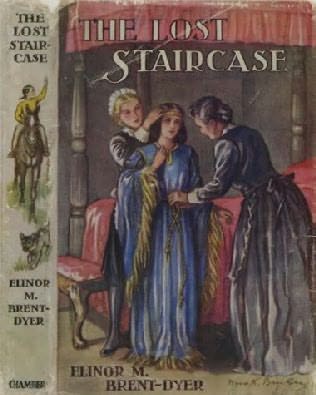
Book 5 - The Lost Staircase

I have two weaknesses when it comes to reading. One is mystery-slash-detective stories (more on that later) and the other is British children's stories written in the first half of the 20th Century. You know, The Secret Garden, The Railway Children, The Famous Five... but I have a particular fondness for books of the Girls Own variety. You know, hockey sticks, midnight feasts, students wearing gymfrocks and calling everything "frightfully smashing!" Enid Blyton's Mallory Towers and St Clare's series are both in the middle of a revival, judging by my last visit to Borders, but my favourite Girls Own author is Elinor M.Brent-Dyer, whose best-known series, the Chalet School, spanned 45 years and 58 books - and she didn't even use a ghost writer. Take that, Francine Pascal and Ann M. Martin!

I've been collecting said series since I was about eight or nine and I'm still twelve books away from completing my collection. These days, the rarest of her hardbacks can go for hundreds of dollars, and I've even seen her paperbacks being sold for $150+. Naturally, the few I have left to go just so happen to be the rarest and the most expensive books to buy, but I live in hope.

Anyway, despite my absolute dedication to the Chalet School, I've never read any of Brent-Dyer's other books, so when a copy of The Lost Staircase came up for sale on trademe at a reasonable price I nabbed it!


Title: The Lost Staircase (1946)

Author: Elinor M. Brent-Dyer

Why this book?
Because of my deep abiding love for Brent-Dyer (see above).

What's it about, anyway?
Sir Ambrose Gellibrand has had his share of tragedies in life, and now, at the age of eighty, he has lost not only his children but all of his grandchildren as well. Realising that he is unlikely to live many more years, he contacts his last remaining heir, who will one day inherit the Dragon House, a large estate nestled on the Welsh border, dating back to the 16th Century.

His last remaining heir turns out to be Jesanne, a fourteen year old girl who is not pleased to be summoned away from her New Zealand farm and her beloved aunt by a cold and distant relative. Incidentally, Jesanne's full name is Jesanne Loveday Balthazar Gellibrand - awesome! What with all this emphasis on people nowadays calling their kids Jermajisty or Space Shuttle or Renesme or whatever, there's not enough children given ridiculously long romantic-sounding names. If I ever have a daughter I'm going to call her Jesanne Loveday Kickass Balthazar Dangerfield so that if she grows up to be a spy she will not only have an appropriate last name - Agent Dangerfield - but she'll also be able to say "Kickass is my middle name".

Anyway, as a 'Colonial', Jesanne struggles at first with the old-world niceties she is now expected to adopt. She doesn't understand why she's supposed to wear gloves outdoors, she hates the fact that she has a maid who actually dresses her in the mornings, and the 'dignity and solemnity' of the butler at mealtimes leaves her speechless. Jesanne is strong-willed, independent and proud, and it is unsurprising that she clashes with her cousin from the very first night of her arrival.

Still, as much as Jesanne misses her own country and her aunt, she slowly learns to love the Dragon House and its grounds. When Cousin Ambrose tells her of the legendary lost staircase, a flight of stairs leading the the Gellibrand's secret chapel which seems to have all but disappeared, her curiousity is piqued. With her cousin's guidance, and the help of her new friend Lois, Jesanne is determined to find out where the staircase is - and why it was hidden in the first place.

The good and the bad:
The worst part about doing a project on the history of book-making is that when I read that the Gellibrand family "Journall" was so old that its paper had been made from rags, and that its quality was inconsistent, I was immediately filled with girlish glee. But moving on.

As a 'Colonial' myself, I find Brent-Dyer's portrait of Jesanne's struggles in the UK to be fairly realistic. New Zealand has always prided herself on being a 'classless' society - and while this is arguably untrue, we have certainly never had the kind of class system that has existed in Britain. While Cousin Ambrose is no longer lord and master of the people in the nearby village, he does still consider it his noblesse oblige to help deal with any problems they face, and in turn relies on their (manual) help at times. The class divides are very prominent and it is only natural that Jesanne will notice this and react against it - although by the end of the book she has clearly absorbed her cousin's views and is prepared to one day take over his role.

Jesanne rebels against both of her authority figures, her cousin and her governess, Miss Mercier. But while Jesanne and Cousin Ambrose's relationship slowly improves to the point that they are able to love one another, Miss Mercier is never treated with much sympathy. It is obvious right from her introduction that she is meant to be an unappealing character; her voice is 'hard', her piano playing is very good, but 'mechanical' - she doesn't have the deeper level of understanding which would allow her to become a truly brilliant musician, and this same lack means she can never be anything but a passable teacher and an unsympathetic person. While Cousin Ambrose and Jesanne bond over their mutual love of the outdoors and animals, Miss Mercier think moonlight walks are silly, and is scared of all dogs, even puppies. While Cousin Ambrose is proud, even arrogant, he ultimately wants to do whatever is best for Jesanne, and is willing to adjust some of his own ideas and prejudices to do so. Miss Mercier, on the other hand, claims to be doing what is best for Jesanne when she is largely acting in her own self-interest.

What makes The Lost Staircase really stand out for me is Jesanne's family history, which is integral to unlocking the mysteries of architecture. How exactly does one misplace a stair? In the case of the Gellibrands, one does it by being Catholic during the wrong time in history - during the English Civil War - and having family members who, although fighting on opposing sides, are unwilling to betray each other. Unfortunately, this backstory is unlikely to make sense to anyone unfamiliar with the Civil War, and is probably the one thing which would make the book unreadable to modern children who would otherwise thoroughly enjoy the story.

So should I read it or what?
The Lost Staircase is very much a product of its time, with its unconscious classism and emphasised "Britishness". There is also a level of religious feeling to the book which I'm sure a lot of people would find off-putting, although as an atheist myself I had no problem with it, since Brent-Dyer's focus is always on the positive aspects of love, understanding and forgiveness. There's an almost innocent quality to the books given its fourteen-year-old protagonist; while Brent-Dyer is not shy on the subject of death, there are are no boys, no crushes, no peer pressure, and certainly no drink, drugs, sex or rock'n'roll - in short, none of the things that we would expect to be included in a book focusing on a contemporary teen heroine.

My judgement? If you know someone with a love for Girls Own, they'll love this book. Otherwise I'd save it for a bright eight- or nine-year-old who is not yet prepared for the ravages of teen angst.